

Please wait while we load the content
Empowering traders through cutting-edge education and premium broker partnerships. Join thousands of successful traders worldwide.
© 2025 Bloomvest. All rights reserved. Empowering traders worldwide.
Made by BirthGiver .
© 2025 Bloomvest. All rights reserved. Empowering traders worldwide.
Made by BirthGiver .
Blogs
the-power-of-confluence-and-trade-review
9 minutes
Part 1: The Power of Confluence in Trade Entries
In trading, no single signal can stand on its own. Experienced traders know that real strength comes from confluence; the point where several technical elements line up and reinforce one another. When that happens, the probability of a successful entry increases noticeably.
Picture a support zone holding firm, an RSI bullish divergence showing up, and a strong bullish engulfing candle confirming the shift. When these pieces come together, the trade isn’t guesswork anymore; it becomes a structured decision backed by logic.
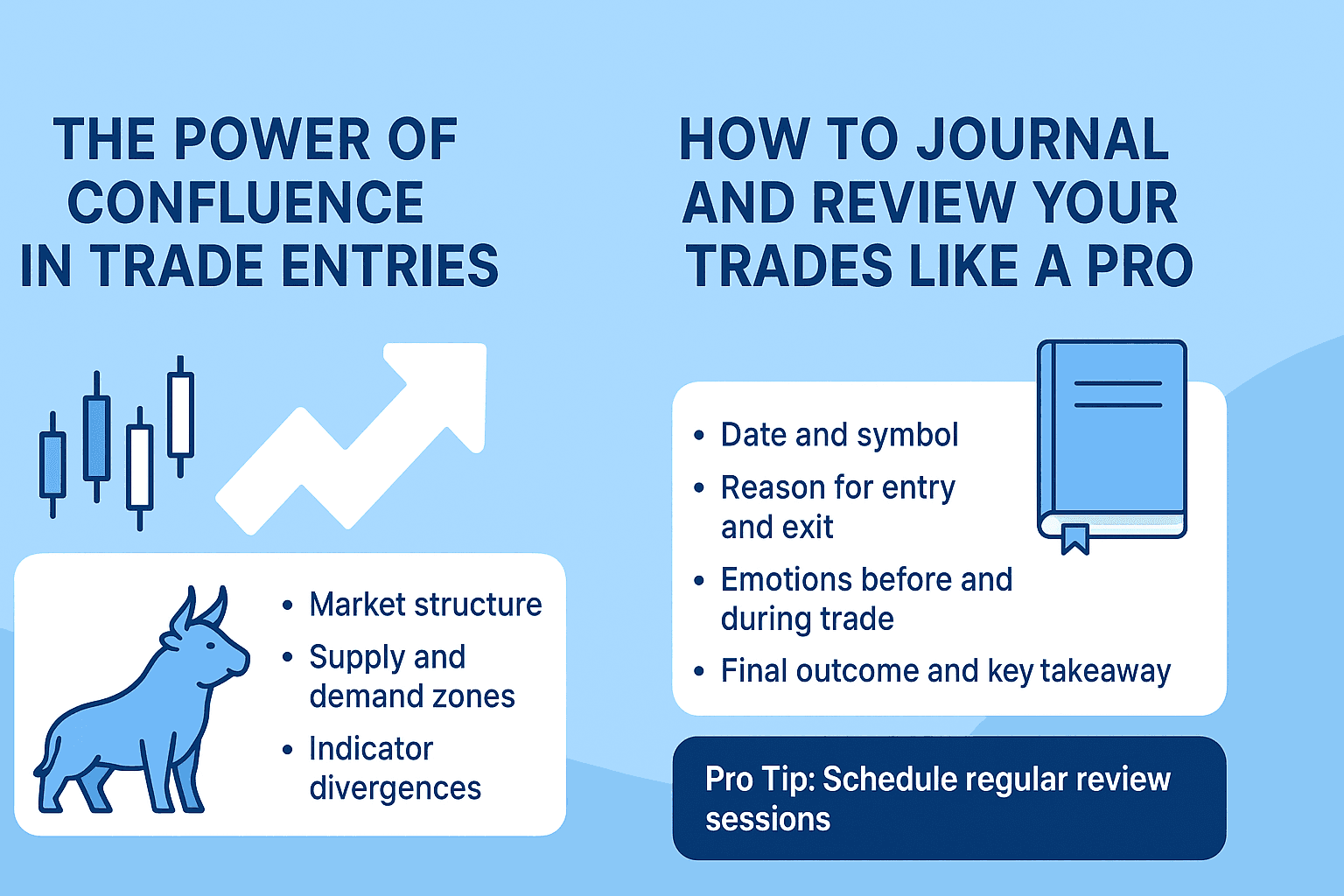
Confluence can come from areas like overall market structure, supply and demand levels, indicator divergences, higher-timeframe direction, or candlestick patterns. What matters most is not the number of signals, but how well they complement one another.
Pro Tip: Before taking a position, ask yourself whether you have more than one solid reason to enter. If those reasons align across different tools or timeframes, the setup is far more likely to follow through. This is how you put the odds on your side.
Part 2: How to Journal and Review Your Trades Like a Pro
One of the most underrated yet powerful habits among successful traders is consistently reviewing their trades. Many traders focus only on getting in or out of the market, but real improvement happens after the trade, during the review.
A proper trade review helps you spot your behavioral patterns. Maybe most of your losses come from emotional entries. Maybe you take bigger risks after a winning streak. Or perhaps you keep hesitating when a clean, high-quality setup appears. Your trading journal reveals these patterns clearly.
A simple journal can include: • Date and instrument • Reasons for entering and exiting • Emotions before and during the trade • Final outcome and what you learned When you review your journal weekly or monthly, your mind starts noticing recurring behaviors. Over time, this process sharpens your judgment and helps you avoid repeating the same mistakes. Journaling is what transforms experience into skill.
Pro Tip: Set a dedicated time each week to review your trades, even if you don’t have many. The goal isn’t to criticize yourself; it’s to understand your thinking process and build more consistent decision-making.
